
Kansas Wesleyan’s Matt Middleton on Competition, Character, and Coaching with Purpose
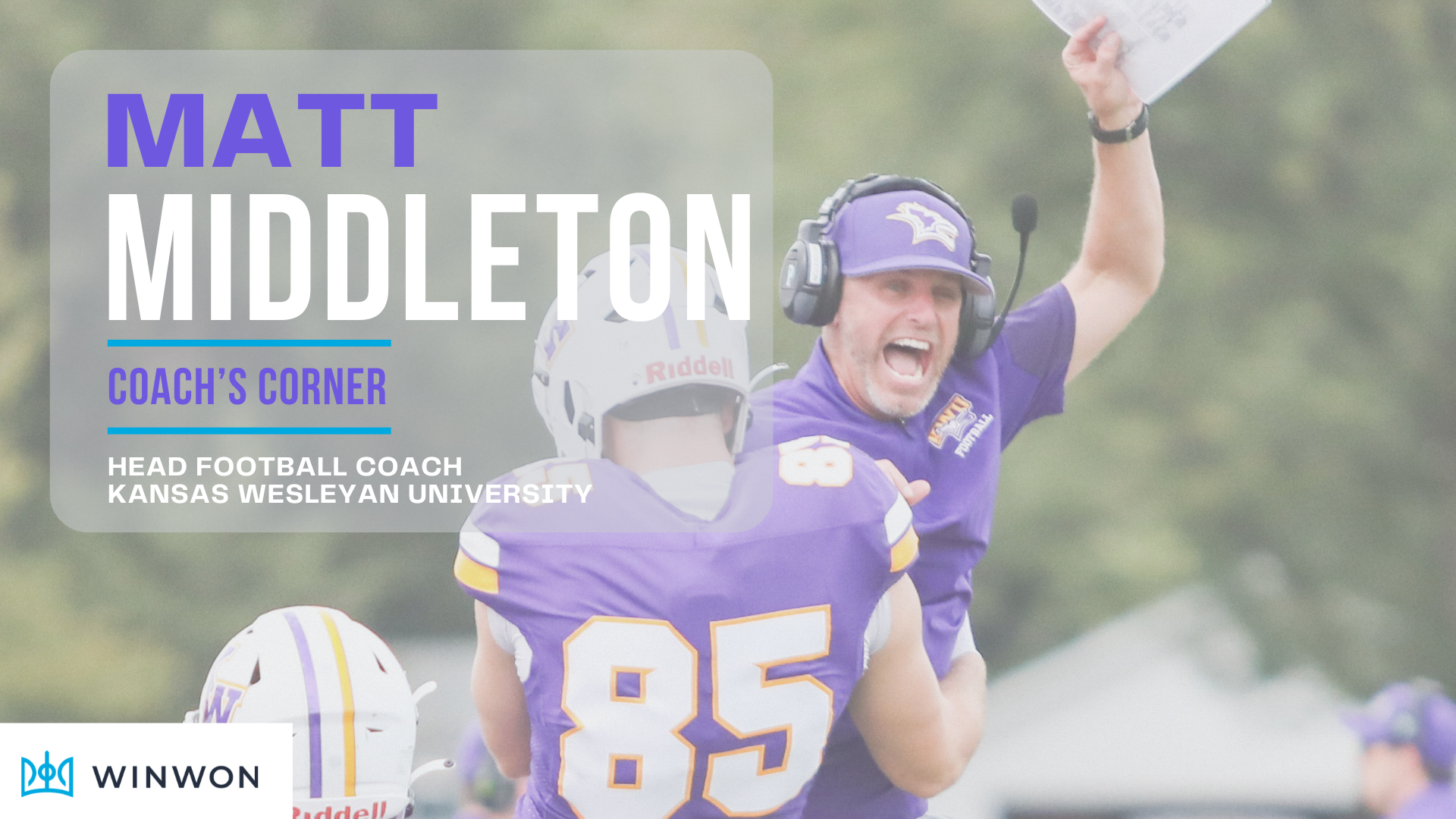
Matt Middleton will be the first to tell you he’s too competitive. Shooting horse in the driveway against his nine-year-old, replaying an opponent’s formations in the back of his mind at the dinner table, grinding through film until his staff has to be run out of the office—the man does not have an off switch. But sit across from him for an hour, and you’ll discover that somewhere between the relentless drive that defined his younger years and the family-first purpose that defines him now, Middleton has landed on something rare: a coaching philosophy that is equal parts fire and support.
In his first season as head football coach at Kansas Wesleyan University, the Coyotes opened with a convincing 27–10 win over Ottawa. It was a fitting debut for a man chosen unanimously from more than 150 applicants. But to understand why Middleton is the right coach for this moment in Salina, you have to rewind—all the way back to a coach’s kid in Louisiana who couldn’t get the competition out of his system.
A Coach’s Kid Who Couldn’t Walk Away
Middleton grew up around the game. His father coached at the Division III level, and young Matt absorbed every whiteboard session and Friday-night atmosphere. He played quarterback and wide receiver at West Monroe High School, won a state championship in 1996, and went on to play at Mississippi College. When his time on the field ran out, he briefly considered a career in sales.
It didn’t stick.
“I compete in anything, but I just couldn’t get the everyday competition out of my system. It’s not healthy.”
He laughs when he says it, but he means it. Ask him what drew him to football specifically and the humor fades into conviction.
Simply put, the sport is hard.“You’ve got to be halfway crazy to enjoy getting hit in 95-degree heat in full pads. And it takes all 11 to be successful. I don’t care if Tom Brady’s your quarterback or Ray Lewis is your linebacker—they can’t do it by themselves.”
That belief—that no single player can carry a team—turns out to be the thread that runs through everything Middleton does: how he recruits, how he staffs, and how he defines winning itself.
The Winding Road
Reading Middleton’s coaching resume will take you on a cross country tour. He started as an FBS graduate assistant, landed his first full-time job at Grand Valley State in Division II, became one of the youngest D-II coordinators in the country, then jumped to the FCS level. At every stop, he was chasing the next rung.
“Now, I recognize it is ok to be where your feet are sometimes. But for me, at that time in my life, it was always chase the next thing.”
The FCS life was demanding. With two young sons at home and a wife managing everything on her own, the math stopped working. Around 2013, Middleton made a decision that surprised some of his peers: he left college football entirely and became a head high school coach in Louisiana.
He stayed for nearly a decade.
It was at the high school level that Middleton says he experienced the most personal growth as a coach. Without the ability to recruit, he had to adapt his schemes to the players who walked through the door. More importantly, he started seeing his players in a new light.
“I coached young men that came to school just to eat. And I coached some that were well off. But I never knew what one of them might be going through in the morning before he got on the bus.”
He also coached his two oldest sons during those years. Watching himself through the eyes of his own children changed the way he spoke to every player on the sideline.
When the itch to return to college football became too strong to ignore, Middleton joined the staff at Harding University, where the Bisons went 26–1 over two seasons and won a Division II National Championship. He credits head coach Paul Simmons with teaching him the long game: stay relational, not transactional, and good things come your way.
Why Kansas Wesleyan
Middleton and his wife, Kayla, passed on two head-coaching opportunities before Kansas Wesleyan came calling. He is candid about why.
“I think you can take the wrong job. If you get caught up in wanting to be a head coach, you may miss the right opportunity.”
What drew him to KWU was the sustained success the program had already built, combined with a university and community that aligned with his values.
Every program in America talks about culture. Middleton is aware of that, and he draws a sharp line between sloganeering and substance.
“A lot of people use culture as a t-shirt slogan. We want great young men that are good football players.”
The vetting process at KWU is unusually thorough. The staff combs through player backgrounds, conducts multiple conversations, and insists on in-person contact before extending an offer. Middleton’s definition of character is simple: “Who are you when nobody’s watching?”
That lens shapes every decision: who gets recruited, how they’re coached, and how long the staff spends in the building each night. Middleton is deliberate about sending his coaches home to be with their own families.
“I used to work insane hours,” he says. “Now I run them out of the office. I don’t want them missing their kids’ activities. I believe you can still win with that balance.”
One of the most revealing parts of any conversation with Middleton is how openly he talks about his own weaknesses. Failure, he says, was the best teacher he ever had.
“I want to hire guys that are smarter than me. Guys that have aspirations to go be head coaches. Because if they have aspirations, they’re going to do their very best at where they are.”
He extends the same philosophy to his roster. If every player on the team had his personality, the program would fail. Different temperaments, different strengths, different ways of processing coaching—Middleton sees that diversity as a competitive advantage, not a problem to solve.
Navigating the New Landscape
Middleton doesn’t sugarcoat the state of college football. The transfer portal, NIL opportunities, and a revolving door of roster turnover have fundamentally changed the business at every level—including the NAIA, where the trickle-down effect is very real.
He points to his own recent experience. During his time at Harding, the Bisons lost their starting defensive end to South Alabama and a starting cornerback to Memphis. Players he helped develop jumped multiple levels. The pipeline now flows upward faster than ever.
Rather than resenting the new reality, Middleton has reframed it. If a player has a standout season and earns an opportunity at a higher level, Middleton encourages the move—the same way he encourages assistant coaches to pursue promotions. The only caveat: he makes sure they understand the full picture.
“Are you a guy, or are you a guy they’re bringing in to be a number?” he asks recruits considering a jump. “Because I’ve been at all those levels, and I can help them see the difference.”
He’s equally passionate about progress toward a degree. The more a player transfers, the more credit hours they lose. Middleton recently talked a talented player out of leaving by walking him through the math: he was too close to graduating to risk losing credits in a move.
Purpose Over Ambition
There’s a wall in the Kansas Wesleyan football offices where Middleton’s priorities are spelled out for every recruit, every player, and every coach to see. Honor God. Be a good husband. Win. In that order. Five or six young boys—the children of his coaching staff—run around the facility on any given afternoon, something he says doesn’t happen at most programs. He allows it on purpose.
At 47, with four sons who keeps him young and a career’s worth of hard-earned wisdom, Middleton has stopped chasing the next thing. He is where his feet are. And the program he’s building in Salina isn’t designed to produce a highlight reel—it’s designed to produce leaders who know how to stay when staying is hard.
That, he’ll tell you, is the whole point.
Keep up with WinWon
See below for recent news and follow us on social media @winwontech
Point University Partners with WinWon to Centralize Compliance, Eligibility, and Communication Across Skyhawks Athletics
%20(3).png)
Lyon College Partners With WinWon to Modernize Athletic Operations and Enable Scalable, Integrated Workflows
%20(3).png)