Moving Mountains: How Marc Benavidez is Turning William Penn Football into a Cultural Heartbeat on Campus
.png)
Marc Benavidez didn't just come to William Penn to win football games. He came to build a culture, and he's proving that when you get the culture right, the scoreboard takes care of itself. It's a philosophy that sounds straightforward until you consider what it actually demands of a head coach — the patience to trust a multi-year process when early results are mixed, the humility to take ownership of every loss in front of your team, and the genuine belief that what happens off the field is just as consequential as what happens on it.
Benavidez arrived in Oskaloosa, Iowa in late 2022, stepping into a program whose previous coach had given 19 consecutive years to the job. Before he ever set foot on campus for an interview, he had done his homework — researching the school, studying the athletic department, and watching every game tape from that season. What he found was a program with the pieces in place and a community hungry for what came next. "From the moment I interviewed, I just felt like it was an absolute sleeping giant," he said. "A place that could be successful, a place that wanted to be successful. Everybody here was extremely welcoming. Everybody was hungry for a change." He came in with a clear five-year plan, shared it openly in his interview, and got to work.
The Builder
To understand Marc Benavidez at William Penn, you have to understand Marc Benavidez at Avila University, because the story of how he built one program from the inside out is really the blueprint for everything he is doing now. He arrived at Avila as a freshman in 2008, a versatile athlete who played quarterback, wide receiver, and defensive back over four years. Upon graduating in 2012, he stayed on as a coach, starting with running backs and moving through a progression of positions — receivers, offensive line, offensive coordinator, associate head coach — until he was named head coach in 2018. By the time he left after the 2022 season, he had posted a 39-12 record and was the winningest coach in program history, having led Avila to its first-ever KCAC championship in 2020 and its first-ever NAIA Football Championship Series appearance in 2022.
What that decade-plus journey gave him was something difficult to teach: a knowledge of a program from every possible angle. He had been the freshman learning the system, the position coach building individual relationships, the coordinator calling plays under pressure, and finally the head coach accountable for all of it. He even spent time as a player on the defensive side of the ball, which gives him an unusual perspective that still informs how he designs and calls offense today. "Playing multiple positions helped out quite a bit," he said. "I probably played more defense in college than I did offense. Even though I'm an offensive guy, I have the base understanding of what our defensive players are going through." That cross-disciplinary fluency is rare, and it shapes not just his play-calling but how he hires, how he teaches, and how he evaluates his own team's performance. "You take care of the little details," he said of his overall philosophy. "The scoreboard will take care of itself."
The Culture
On his first day at William Penn, then-Athletic Director Nik Rule — now the Commissioner of the Heart of America Athletic Conference — told Benavidez something that has stayed with him ever since: football moves mountains. It wasn't meant as inspiration. It was closer to an orientation, a description of the responsibility that comes with leading the largest single demographic on a small college campus. With over 150 players, the football program touches the student body in a way no other sport can, and the way those players carry themselves — in classrooms, at other teams' competitions, around Oskaloosa — shapes the identity of the entire athletic department.
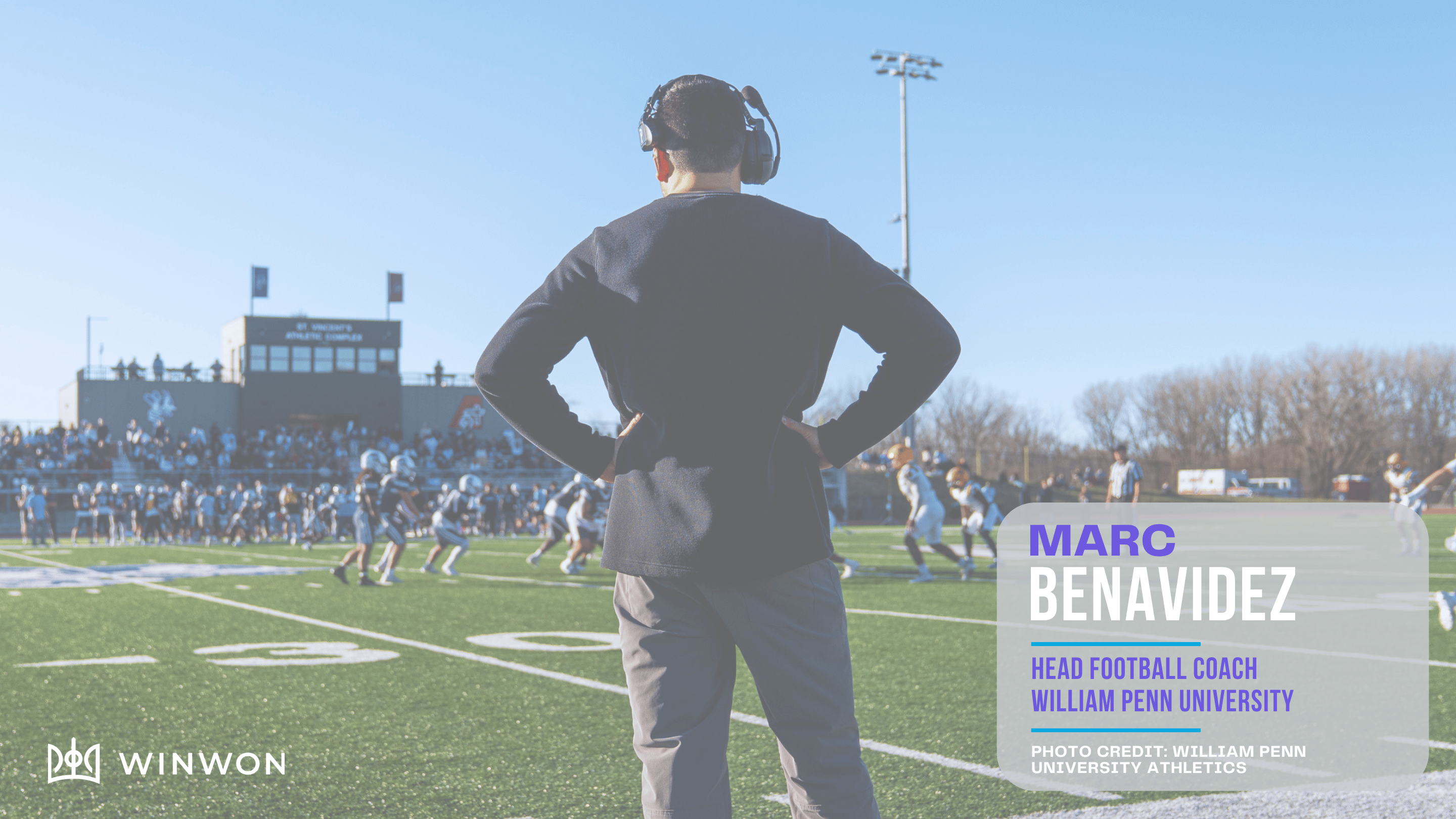
Benavidez took that framing seriously from day one. He actively encourages his players to show up for other programs on campus, understanding that the presence of 50 football players in the stands of a volleyball match or baseball game is genuinely meaningful for those student-athletes and for the culture of the department as a whole. "If I can have 50 of our 150 football players at a soccer game, a baseball game, a softball game, a volleyball game — that's a huge boost to the people watching that sporting event," he said. "Right now there are a good number of ranked teams here at William Penn, and we want to support them. If we do, they'll give us the support as well." It becomes a cycle — one team showing up for another, and over time, an entire athletic department that feels connected rather than siloed.
It is exactly what Rule envisioned when he hired Benavidez. "Football is uniquely positioned to be a connector on a campus," Rule said. "It can bring alumni home, energize students, and create momentum across every program. But that only happens when the head coach views the role as bigger than the locker room. When football becomes a cultural enhancer — not just a competitive unit — it truly can move mountains. Marc understands that responsibility, and that's what makes his leadership special."
That culture doesn't build itself in the daylight hours alone. On Friday nights at 11 PM, when most college students are out or winding down, Benavidez opens the indoor facility for what he calls "Party in the Pack" — a voluntary workout where players who want to put in extra work can do it together, as a group, at exactly the hour when the social pull of college life is strongest. "Understanding that this extra work is going to help us win those tight games," he says. Nobody is forced to be there. That's what makes it mean something when they are.
The Process
In an era of transfer portal chaos and instant gratification, Marc Benavidez is building something rare: a program where the five-year plan actually means five years, and the young men who believed in it from the start are the ones now writing history. This past season — William Penn's most wins since 1896, a first-ever home playoff game — was not a sudden breakthrough. It was the compound interest of three years of unglamorous, deliberate work.
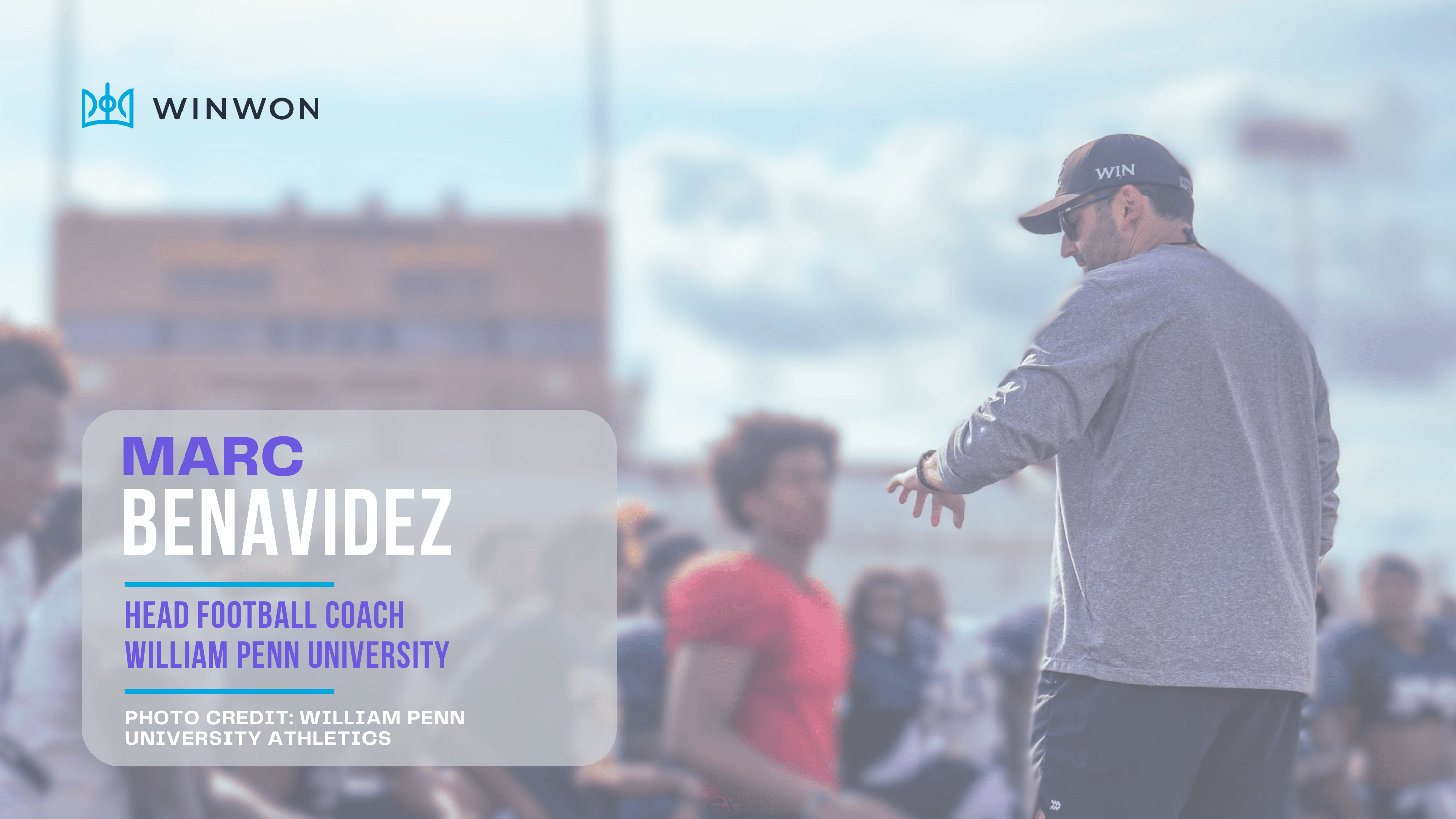
Years one and two with Coach Benavidez were not easy. William Penn lost 12 games total, eight of them by a touchdown or less, each one a game where the gap between winning and losing came down to a single stop, a single conversion, a single decision. The players who arrived as freshmen in 2023 had every opportunity to weigh their options and look elsewhere, and many players at other programs in similar situations do exactly that. These players stayed. "Fortunately, guys from the jump believed in us as a program," Benavidez said, and that buy-in became the foundation everything else was built on.
The most vivid proof of what that commitment can produce is the running back who arrived as a freshman with roughly 200 total yards to his name and left as a senior with 32 touchdowns and nearly 2,000 yards in a single season. That arc happened through the weight room, through a scheme built deliberately around his strengths, and through the culture of accountability that surrounded him every day. Benavidez is direct about the coaching philosophy behind it: "Players win games and coaches lose them. What can we do to get those players in a good spot to where they can go be successful — win games, and go be successful after college as well." For him, player development and player retention are two sides of the same coin. If you build an environment where players are genuinely growing, genuinely winning, and genuinely supported academically and personally, the transfer conversation largely takes care of itself. "The grass isn't always greener," he said. "If you give these guys a great environment where they can enjoy it, where they can win games, where they can get bigger, faster, stronger, where they have academic resources — you put them in a good spot to not want to go find something else."
Even now, with 11 wins and a historic season behind them, Benavidez is careful not to let the program rest on what it has accomplished. There are still goals that haven't been reached, conference standards that haven't been met, and a five-year plan that has a few chapters left to write. "We have not reached all of our goals," he said plainly. The mountain is still being built.
The Mission
Marc Benavidez was shaped by coaches who showed up for him when it mattered most, and now he pays that forward every day at William Penn — not just as a football coach, but as a consistent and accountable presence in the lives of young men who need one. He speaks openly about the father figures he found in coaches growing up, particularly during a stretch when his stepfather was deployed overseas following 9/11 and it was largely just him, his sister, and his mom. The coaches he found during those years gave him something he has never forgotten, and it is very clearly part of why he does what he does now. "We try to be a hundred percent honest with our guys," he said. "You've got to love them up and hold their hand at times. But they need to see there are consequences for their choices."
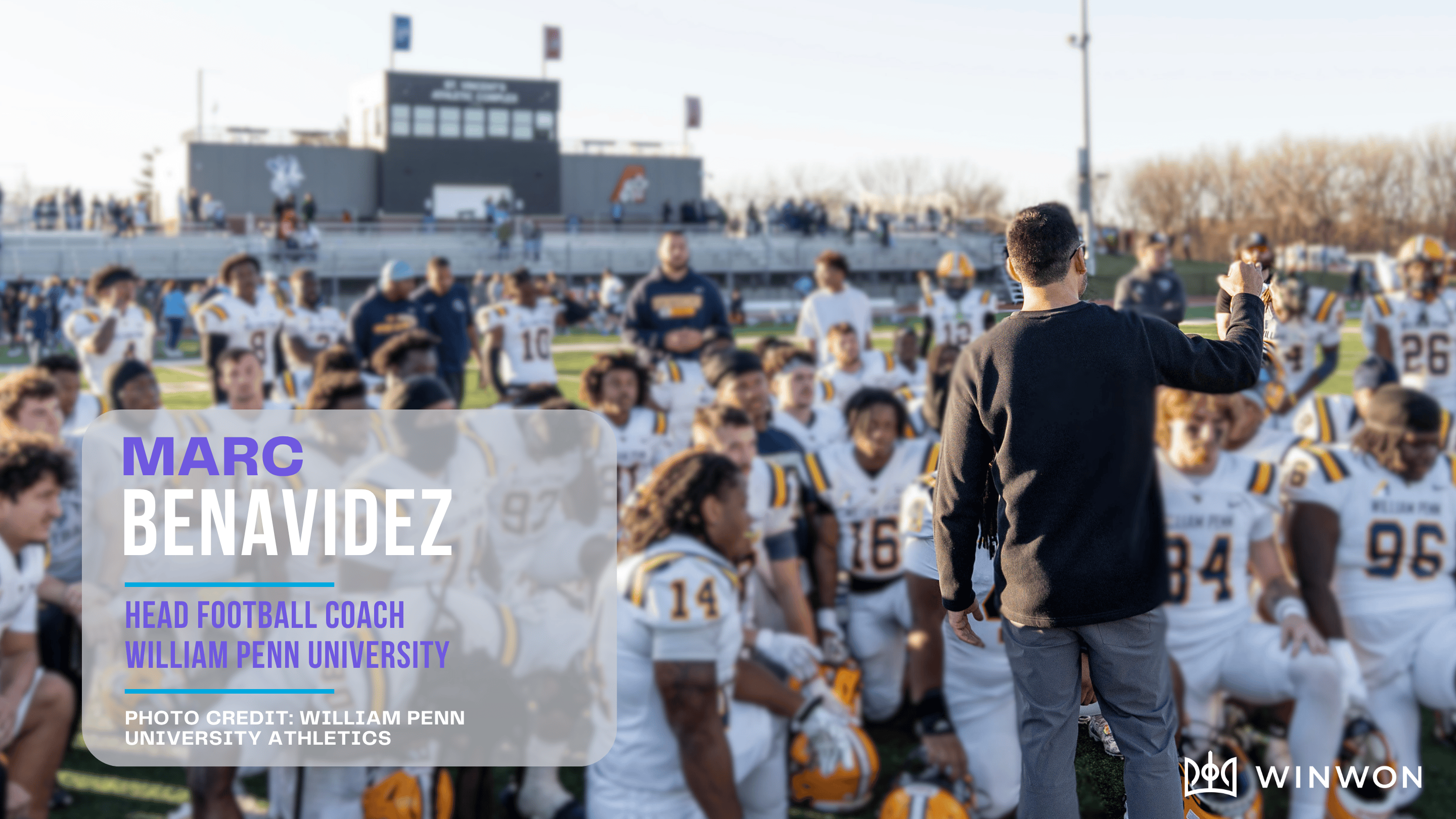
He shows his players what that kind of honesty looks like by modeling it himself. When the team loses, he takes ownership publicly and directly, because he believes that when a coach does that consistently, it becomes easier for players to do the same — and a team where everyone takes ownership is a team that can actually move forward together after a tough loss. He keeps his door open for real conversations. He shows up at 11 PM on Friday nights. He is on the practice field on Thanksgiving in 12-degree wind chills. His players feel it not because he tells them he cares, but because he keeps showing up in the moments that are easy to skip. "They've got to feel it," he said. "I can't just fake it. That relationship piece just takes time."
When asked where he wants his career to go from here, he doesn't reach for a ladder to climb. He talks about finding places that trust him to do the work, communities that want to be part of something, and programs where he can keep doing what he loves with people who are all pointed in the same direction. "I could be doing this until I'm in my sixties or seventies and still feel relatively young," he said. That is not the answer of someone with an exit strategy. It is the answer of someone who already knows exactly what he's doing and why.
Success at small college programs, he said early in our conversation, is all about the people. At William Penn, in Oskaloosa, Iowa, Marc Benavidez is proving that when you invest in those people, with patience, grit, and genuine care, you can achieve some pretty incredible results.
Keep up with WinWon
See below for recent news and follow us on social media @winwontech

WinWon Founder, Alex Hanley, Joins Inside Impact
Mount Saint Mary College Partners with WinWon to Strengthen Recruiting Structure and Department-Wide Pipeline Visibility