
Coach’s Corner Welcome's Kevin Kuhn
Why Running Is the Best Teacher in Sports
Ever wondered how much time you should really dedicate to your training? For kinesiologist and running coach Kevin Kuhn, M.S.Ed., MFS, the answer has less to do with mileage charts and more to do with something harder to measure: your willingness to show up, stay consistent, and fall in love with a long-term process.
Based in Dallas, Kevin has lived nearly every chapter of the runner’s story:
- high school athlete from a tiny Ohio school
- Junior Olympic competitor
- steeplechaser in college
- coaching post-collegiate athletes chase Olympic Trials qualifiers with the Indiana Invaders
- injured distance runner who couldn’t run for a decade
- and now, a coach and kinesiologist helping athletes get fast, stay healthy, and—crucially—enjoy the sport.
This Coach’s Corner dives into Kevin’s journey, his philosophy on training and life, and how he teaches athletes to pursue ambitious goals without burning out.
Kevin didn’t grow up specializing in running. Like a lot of kids, he played “a little bit of everything”—basketball, soccer, and whatever sport was in season. His dad had done a bit of running in high school, so the encouragement to try running was there early. And like many future distance runners, the first hints of potential showed up on school field days.
His first real running season didn’t come until his freshman year of high school, but he was hooked quickly. “I absolutely loved it,” he says.
Kevin went to a tiny high school—only 41 students in his graduating class. In Ohio’s Division III system, he might only face a handful of strong competitors at a time. Junior Olympics changed that.
All of a sudden, he wasn’t just racing a few good runners from small schools. He was lining up with state champions from Division I powerhouses and seeing what truly high-level high school running looked like.
“I got to see what those athletes were doing. A lot of them were state champs. And they ran every day."
That exposure—to high standards a commitment to consistent training—became his first real lesson in what long-term development actually looks like.
Learning to Love the Steeplechase
Kevin’s coach suggested something that intimidates a lot of distance runners: the steeplechase.
Hurdles. A water pit. Endless laps. Cold water. Mistakes that may cost you more than seconds—they could end your race.
For Kevin, it sounded like a challenge worth leaning into: "Hurtling and jumping into a water pit just was not as scary of an idea to me.”
He breaks down the event like a coach who’s lived it:
- The key is maintaining momentum, not staying dry.
- You accelerate into the barrier because you know you’ll slow down on landing.
- You aim to land with one foot in the water, about ankle-deep, to reduce impact and get back to running quickly.
“The steeplechase is brutal,” he says. “But having a little more natural speed and athleticism meant I could tolerate the stresses and not get beaten down as much.”
Even then, Kevin didn’t know that his interest in movement quality and resilience would later shape his entire career.
A Career Changing Injury
Ironically, the moment that altered Kevin’s relationship with running didn’t happen in a race or workout. It happened at the end of a high school track meet he was helping host in college.
He and others were moving a set of small bleachers—nothing unusual. But fatigue, poor form, and “frail distance runner” strength caught up with him.
“I lifted these bleachers and saw stars right away. Within five minutes, I couldn’t move.”
What he initially thought of as a “back injury” turned out to be more complicated. Yes, his back hurt in the moment, but the real problem was chronic:
- Hip flexors so tight that his pelvis was stuck in anterior tilt
- Lumbar spine compressed all the time
- A pattern that made running feel like pain, not joy
That injury took him out of competitive running for almost ten years, but it also pushed him deep into kinesiology, injury prevention, and corrective exercise. He learned how to:
- reduce his hip flexor tension
- strengthen his lower abdominals
- correct his pelvic position
- even how to breathe and move differently
In the process, he wasn’t just rehabbing his body—he was building the toolkit he’d later use as a kinesiologist working with injured athletes and those who want to avoid injury in the first place.
Coming Back as a Coach–Athlete
When Kevin eventually got back into run coaching, he made a decision: he didn’t want to be a coach who only explained things verbally. He wanted to be able to demonstrate them.
“As a strength coach, it’s super important that you can demonstrate: here’s how you squat, here’s how you deadlift. With run coaching, I wanted my athletes to know: if they could beat me, they were going to be really good.”
That meant confronting his history with injury and getting serious about his own training again. It also meant testing how strong and fast he could become in his late 30s with a healthier, more holistic approach.
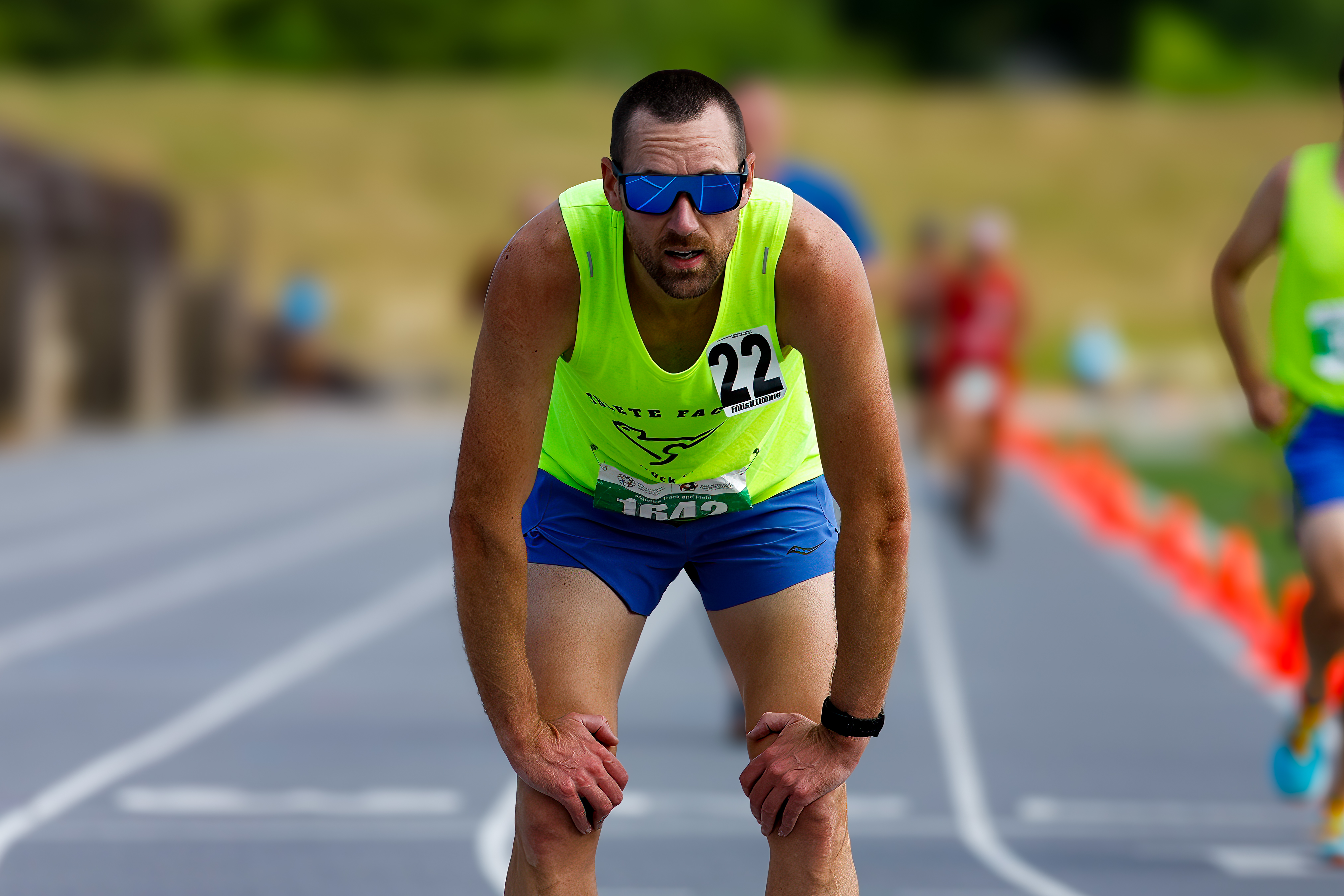
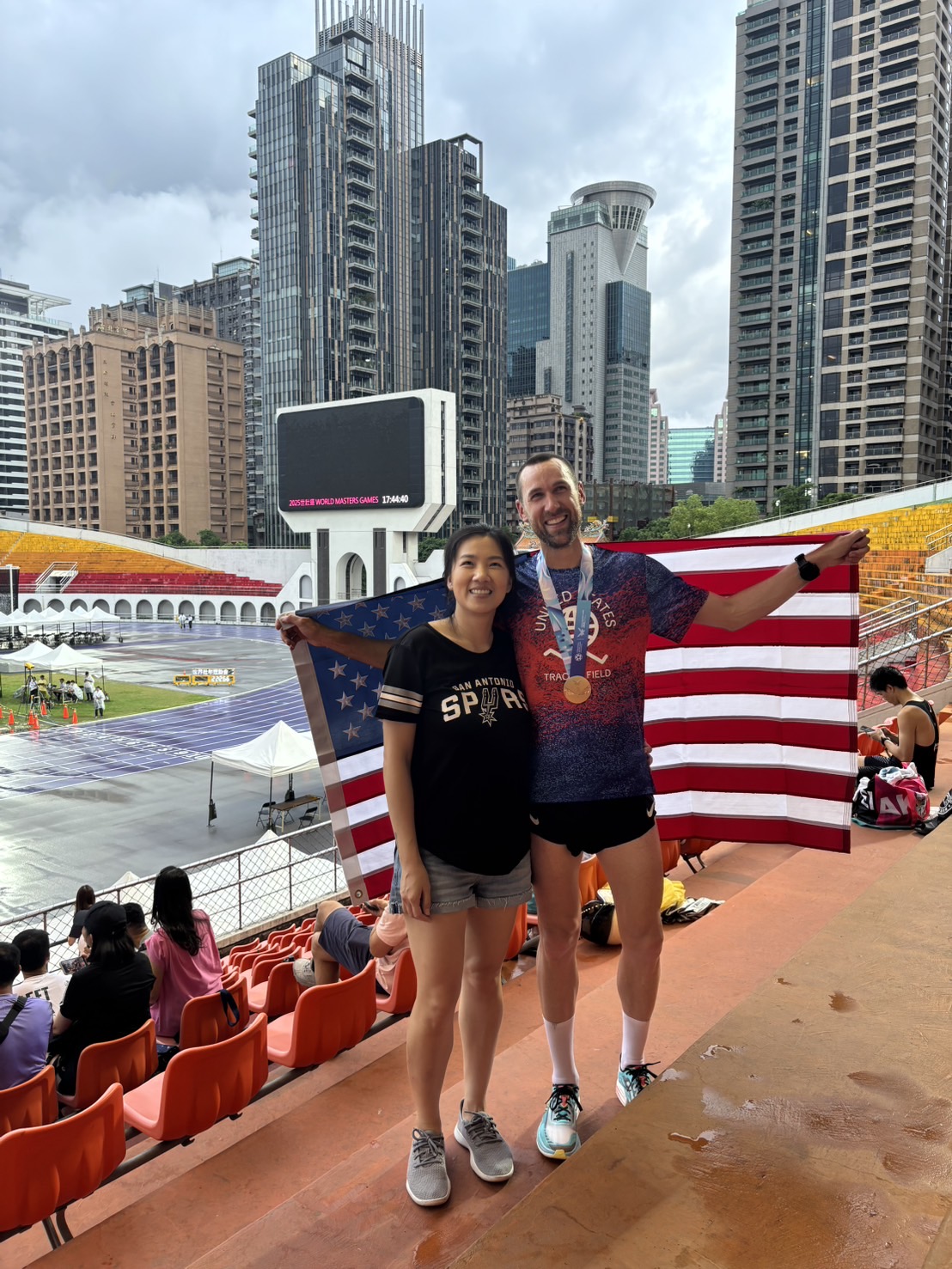
He ended up running 5K and 10K times faster than he did in college, and even competed at the Masters World Championships, taking home the Gold in the 10k and 5k and silver in the 1500m
Asked about his 5K ability today, he estimates:
“If I was just focusing on the 5K, probably low 16s or a little under. For a 39-year-old, that’s not too shabby.” At the same time, his athletes have started to catch him and, of course, give him a hard time about it.
“Most of the kids are like, ‘Coach, you’re starting to get slow.’ And I’m like, yeah, you know you’re right.” He takes it in stride. That balance of humility and competitiveness shows up in how he coaches—and in how his athletes respond.
The Marathon Question: “Do You Really Have Time for This?”
Kevin hasn’t run a marathon. Yet.
“I don’t want to do a marathon until I’m ready to race a marathon.” For him, the conversation about marathons isn’t primarily about distance. It’s about time, life, and purpose.
He has clients who train 60–70 miles per week and others who do full Ironman triathlons—people who end a grueling swim and bike with a marathon. He’s impressed by them. But as a coach, he’s careful not to romanticize the commitment required.
“There’s a difference between training to do an event and training to race an event.”
That distinction shapes his advice. He often finds himself talking as many people out of signing up for a marathon as into it.
Why? Because the real cost isn’t just long runs on Saturdays. It’s:
- extra sleep
- recovery time
- mental bandwidth
- and the reality that training at a high level often means taking time away from other important parts of life
“If it’s breaking you down, if it’s not adding to your life, if it’s actively taking away from your ability to do the other things in your life that are really important, that’s a problem. A lot of it is a time management issue—how much time can you fully commit to training for a marathon?”
For Kevin, that’s what good coaching looks like: helping people choose goals that fit their life.
How to Fall in Love with Running: Easy Days, Joy, and the Right Rhythm
“What I enjoy the most about running are the easy days,” he says. “If I’m going to run six or seven days a week, more than half needs to be easy.”
“Easy” doesn’t mean “effortless.” It means the effort is sustainable, usually in the 3–5 range on a 1–10 RPE scale, where:
- 0 = no effort
- 10 = all-out
- 3–5 = “sustainable, conversational pace”
The way he structures a training week captures his rhythm:
- Monday – Hard
- Tuesday – Easy
- Wednesday – Hard
- Thursday – Easy
- Friday – Easy
- Saturday – Hard
- Sunday – Long, but relatively easy
That “wave” pattern of hard and easy isn’t just physiological. It’s psychological.
- Hard days sharpen you.
- Easy days keep you enjoying the sport.
He also believes that easy runs shouldn’t always be solo. “The easy run is where you get to know your teammates. The hard workouts, that’s where you make each other sharp. But on the easy days, you’re running with your friends, trying to make each other laugh, joking, gossiping, hanging out. That’s where it’s fun.”
When athletes associate running only with grind, intensity, or punishment, they burn out quickly. When they associate it with connection, growth, and progress over time, they stay.
Running is Life
If there is one core belief that seems to anchor Kevin’s entire coaching philosophy, it is this: “Running is the closest proxy for life.”He doesn’t say that lightly. He explains it in two big dimensions.
1. Delayed Gratification
“It’s hard to teach someone delayed gratification in sports the way that you can learn it in running. Life is all about delayed gratification.”
Most of the best things in life—degrees, careers, buying a home, building a family, developing mastery—take years or decades. Running gives that same pattern in a more approachable form:
- You don’t get faster in a week.
- You rarely see meaningful changes in a month.
- But over 6–12 months, consistent training transforms you.
Kevin trains his athletes to adopt the right time horizon for evaluating progress:
- Don’t obsess over week-to-week fluctuations.
- Look at 3–6 month blocks. That’s where the story shows up.
2. Life Isn’t Fair—and You Have to Show Up Anyway
Even when you do everything right, running can hand you a bad day.
“You can be super fit, at the top of the world, and then have the worst day of your life in running.” You can eat well, sleep enough, follow your plan, and still encounter disappointment, injury, or circumstances outside your control.
His expectation for injured athletes is telling.
“Even if you can’t show up and do the thing that you love, I still expect you to show up and support your teammates. To be someone other people can rely on.”
To Kevin, running is a lower-stakes environment to learn the most important high-stakes life lessons:
- resilience
- reliability
- doing hard things over and over
- and refusing to look for shortcuts
“You’re going to be a better friend, a better partner, a better employee or boss because of the things that running teaches you.”
Set the Goal. Then Break It Down and Let It Go.
Kevin encourages athletes to set big, audacious outcome goals—goals that may even feel out of reach.
- A high school girl wanting to run under 5:00 in the mile.
- A new marathoner wanting to finish with a PR.
- A returning runner aiming to PR in the 1600M after years away.
But he pairs that with an equally strong message: you can’t control outcomes.
So what do you do? You break it down.
“Once we set that goal, then we work backwards. What does that look like on a monthly basis? On a weekly basis? What do I need to do on a daily basis? Maybe even hour by hour.”
The process looks something like this:
- Define the outcome
– e.g., “I want to run under five minutes in the mile.” - Translate to volume and structure
– How much training do we generally need to accumulate? - Break it into time blocks
– Monthly targets
– Weekly mileage and workouts
– Daily actions (runs, mobility, sleep, nutrition) - Get hyper-focused on the process
– Show up. Hit the effort. Execute the plan.
At that point, something shifts.
“When you break it down, all of a sudden it looks much more achievable. You set the outcome, then you get hyper-focused on the process until you love the process. Then it doesn’t matter whether you hit that outcome or not. It’s who you become by locking into the process that ultimately provides so much more meaning.”
That’s where Kevin’s philosophy overlaps perfectly with the mindset we champion at WinWon:
- Keep Playing – keep showing up, especially when it’s hard
- Break It Down – take something that feels impossible and turn it into a series of steps you can actually complete
What Kevin Kuhn Wants Athletes to Take Away
If you zoom out from the stories, the steeplechase details, the Masters races, and the back injury, a few themes stand out clearly in Kevin Kuhn’s approach:
- Consistency beats intensity
Run often, not just hard. Easy days and long-term rhythm matter more than heroic single workouts. - Movement quality and resilience matter
General athleticism, mobility, and strength allow you to tolerate stress, handle quirky events like steeplechase, and avoid injury. - Big goals are good—but they’re not everything
Use them to frame your process. Then release attachment to the outcome and commit to who you’re becoming along the way. - Running is training for life
Delayed gratification, unfair setbacks, and the responsibility to show up for others—even when you’re struggling—are all built into the sport.
Above all, he wants athletes to enjoy the journey enough to stick with it long enough to see what they’re truly capable of.
If Kevin’s story leaves you thinking about your own training, ask yourself:
- What would consistency actually look like for me over the next six months?
- What’s one big outcome goal I can set—and then break down into a process I can fall in love with?
Because if there’s one thing Kevin Kuhn has learned from a lifetime in running, it’s this: You just have to keep showing up, one well-chosen step at a time.
Keep up with WinWon
See below for recent news and follow us on social media @winwontech
Point University Partners with WinWon to Centralize Compliance, Eligibility, and Communication Across Skyhawks Athletics
%20(3).png)
Lyon College Partners With WinWon to Modernize Athletic Operations and Enable Scalable, Integrated Workflows
%20(3).png)